If you’ve been on a discovery call with us lately, there’s a good chance you’ve asked some version of this: “Are you keeping up with AI search? Should I be doing something different? Is our SEO strategy even still relevant?“
We hear it every week. The signals are mixed, and that makes sense. Traffic is down for a lot of businesses. AI Overviews are dominating the top of Google. People are using ChatGPT like a search engine. A growing number of vendors are pitching something called GEO (Generative Engine Optimization) or AEO (Answer Engine Optimization) as the thing you urgently need to do right now.
We know it’s a stressful position to be in, especially when you’ve been investing in SEO and aren’t seeing the results that you did two years ago.
But SEO isn’t dead.
Lazy SEO – the kind built on high-volume thin content, keyword stuffing, and shortcuts that game algorithms without actually helping anyone – is on its way out. That’s not really news, though. AI has just accelerated the reckoning.
Every AI Search Result Traces Back to SEO
Every citation in ChatGPT, every source in Perplexity, and every result in a Google AI Overview comes from a page that ranks. That’s not an opinion. It’s how the underlying technology works, and it’s the part that gets glossed over in most AI search coverage.
These tools use something called retrieval augmented generation, which means that before an AI can cite or summarize content of any kind, it retrieves it from a search index.
Those indexes are, overwhelmingly, Google’s. Multiple independent studies have traced ChatGPT’s citations back to pages with strong organic rankings. Google’s own AI products are built directly on top of Google’s index, confirmed publicly by Google employees.
The brands appearing in AI responses didn’t get there through a new optimization checklist. They got there because they already had solid SEO.
So when someone tells you SEO is dead and AIO/GEO is the future, what they’re usually doing is rebranding things that have always mattered: clear writing, structured content, authoritative sources, solid technical infrastructure. It’s a compelling pitch. It’s just not how we work.
What AI Search has Actually Changed
AI search has changed user behaviour, and the clearest sign is in traffic data: informational queries that used to drive clicks (usually to blog posts) are increasingly being answered before anyone visits a website.
We’ve seen it on our own site and our clients’, and the broader data confirms it.
- Chartbeat tracking across thousands of publisher sites found that small publishers lost around 60% of their search referral traffic over two years
- Around 60% of Google searches now end without a single click, up from 50% just a few years ago
Zero-click search is real, and it’s growing. AI tools are absorbing a lot of informational search intent queries, making it possible for people to get quick answers without visiting a website. We’re not going to pretend otherwise.
The screenshot below is taken from our website’s GA4 data. It shows how our organic search traffic was performing in 2023, early 2024, and then after AI Overviews were rolled out in the US (our primary source) and Canada (our secondary source).
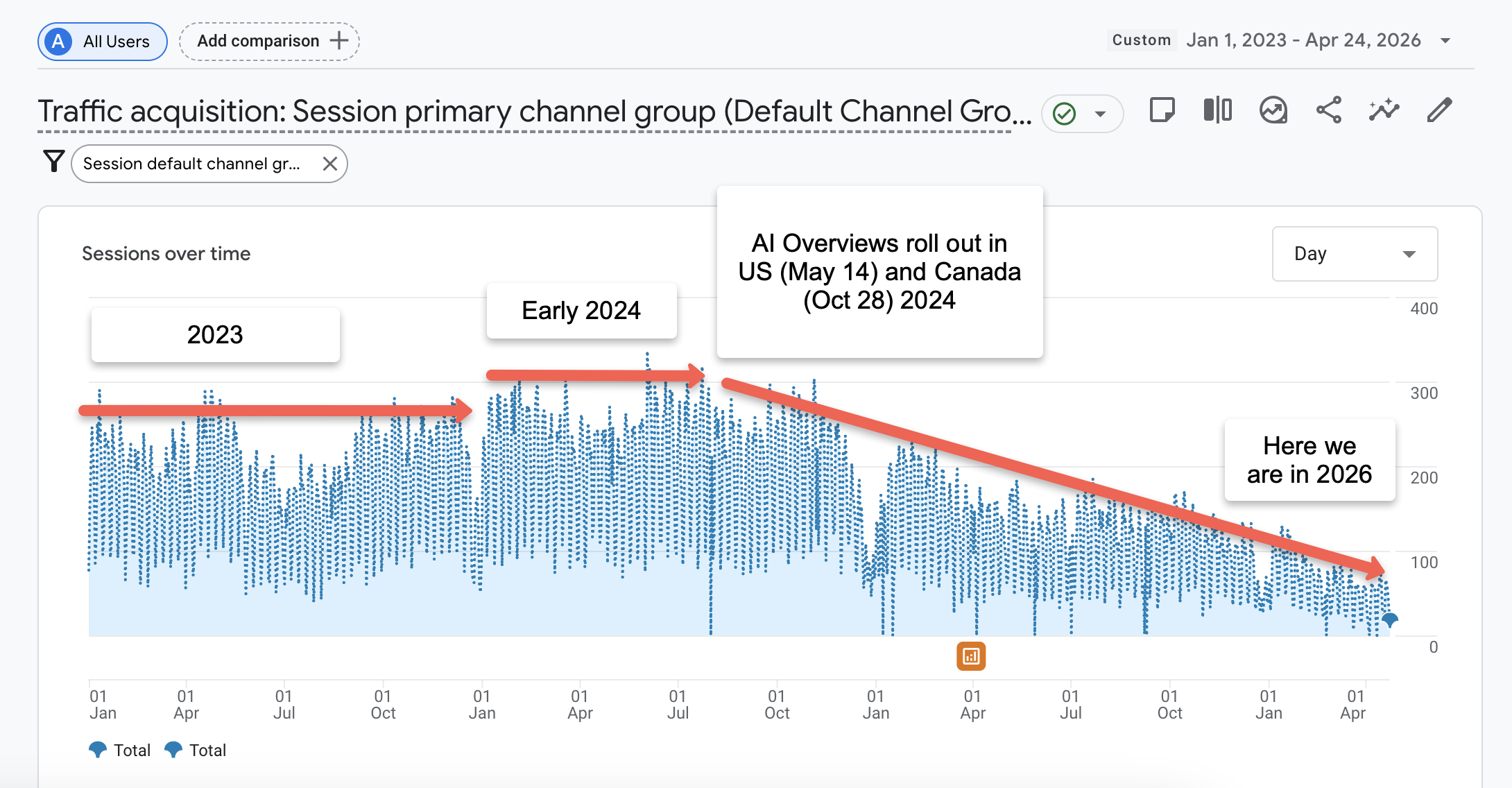
Our pages were not impacted like this. Our homepage, case studies page, and service pages have seen either increased search traffic or tiny decreases. But our blog posts, which previously reached hundreds of people per day, saw decreases of anywhere from 20-80%. This is because the topics they cover are now summed up in zero-click summaries.
What all of this means in practice: the visitors who do click through are often further along in their decision-making. They’re not there to casually browse. They want depth, proof, or they’re ready to act.
One stat worth keeping in mind: research suggests the average visitor arriving from an AI search tool converts at more than four times the rate of a traditional organic visitor. Fewer clicks, but a totally different kind of visitor.
Raw traffic numbers can look lower even when your SEO is working. Fewer casual browsers landing on your site isn’t the same problem as fewer potential clients. Worth checking your leads and conversion data before drawing conclusions from traffic alone.
The bar for being worth a click has gone up. If your blog post covers the same ground that ChatGPT can summarize in a few seconds, it’ll get skipped by the AI tools deciding what to surface – and also by users.
This brings it back to good SEO. The content that earns clicks and citations offers something a summary can’t replicate: specific experience, proprietary data, a genuine point of view, or depth that actually rewards the reader.
Smart SEOs have been saying it for years. AI has just raised the stakes.
Why Human-First Content Was Always the Winning Strategy
Every major algorithm update in the last decade has had the same focus: penalize thin content and keyword manipulation, reward experience, expertise, authority, and trust.
AI search hasn’t changed that direction. If anything, it’s accelerated it.
The sites that chased shortcuts, content written for crawlers rather than people, FAQs generated from keyword tools rather than real customer questions – those are the sites feeling the most disruption right now. Sites with strong content foundations are still seeing traffic shifts from zero-click search. That’s structural, and nobody is immune. The difference is they’re not also losing ground to technology changes on top of it.
This is the part that frustrates us about how GEO and AIO are being marketed. The advice circulating in SEO circles right now (add FAQ sections, implement schema markup, earn third-party citations) isn’t wrong. It’s presented as a novel AI strategy and a tactical pivot, when it’s really just solid SEO practice that everyone should have been doing all the time.
New labels. Same fundamentals. The one difference is execution.
The FAQ section that actually moves the needle isn’t generated from keyword tools. It’s built from the real questions your prospects ask on sales calls, in their own words, before they even know the name for what they need. There’s a meaningful difference between actual frequently asked questions and a list that’s added for the sake of having FAQs and doesn’t reflect the real questions a person asks your team (and would type into an AI engine).
AI can answer questions. It can’t replace proof, credibility, or the conversion architecture that turns a curious visitor into a client. That still lives on your website, and it still needs to be built thoughtfully.

Accessibility: The Underrated Part of This Shift
Good accessibility practice and good SEO practice point to the same technical decisions, and AI search has made that overlap more consequential than ever.
A lot of what makes content accessible to humans also makes it parseable by AI:
- Proper heading structure
- Descriptive link text
- Logical content hierarchy
- Alt text on images
- Short, clear paragraphs
These aren’t just considerations for users with disabilities or people on slower mobile connections. They’re the same signals that help AI tools understand what a page and its content are actually about.
If your website is hard to navigate, slow to load, or structured in a way that buries your most useful content, it creates friction for everyone – users with screen readers, people who skim, mobile users, and the crawlers deciding whether your content gets retrieved at all.
Get those things right, and you’re not just ticking accessibility boxes. You’re building a site that’s easier for every kind of visitor to use, and easier for every kind of search system to understand and surface.
The Shortcuts Worth Skipping
Some of the most widely promoted AI search tactics are actively risky, because they work by gaming retrieval systems rather than earning genuine authority, and those systems are getting better at detecting the difference.
- Rapidly scaling AI-generated content can look like it’s working for a few months, then a core update arrives and the temporary traffic inflation collapses
- Self-promotional comparison content (articles that position your own product as the top option in its category) is being targeted by more recent Google broad core algorithm updates, and it can take years for a site to recover
The deeper issue is that most businesses don’t lose rankings from one dramatic mistake – they lose them through dozens of neglected small ones. If a tactic works by exploiting a gap in how AI and search systems detect manipulation, those systems will close that gap.
The brands investing in real content and real SEO fundamentals now are the ones who will still have search presence in two years.

What to Actually Do Next
The most effective response to AI search isn’t a new strategy, it’s doubling down on the same things that have always driven sustainable search visibility.
1. Invest in content that earns its place
Real depth. Real perspective. Your own data and experience.
Don’t write what AI can already summarize, write what it can’t. We tell clients the same thing we’ve always told them: write for humans, not algorithms. The algorithm always catches up, eventually.
2. Mine your own customer conversations
What do prospects misunderstand before they start working with you? What objections come up on every call? What do clients wish they’d asked earlier? Those are your best content topics: actual human intelligence from your own business, not keyword tool outputs.
3. Get your technical foundations right
Site speed, mobile responsiveness, clean structure, and accessibility. These are what drive a usable, helpful website. Most businesses have more gaps here than your realize, and they compound quietly.
Our content optimization checklist is a good place to start.
4. Reframe how you measure success.
Fewer casual browsers is not the same as fewer leads. Check your conversion data before drawing conclusions from traffic numbers alone.
We’ve watched this play out on our own site over 12+ years of blogging. Traffic dips when we go quiet, it climbs when we publish consistently, and the posts that perform best are always the ones that answer a real question with real depth.
The GEO era hasn’t changed that pattern. It’s made the stakes clearer.
Is SEO Still Worth It?
Yes. Unambiguously.
The brands showing up in AI responses are the brands with strong SEO foundations, because AI retrieval runs through search indexes, and search indexes reward the same things they always have. The playbook has evolved, but the underlying principle hasn’t: build something that actually serves the people you’re trying to reach, and the visibility tends to follow.
If your traffic is shifting and you’re not sure what it means, we’re always happy to help you separate noise from real opportunity. Take a look at our SEO consulting services to see how we approach this for clients.
Share post:

About the Author
More by This Author