We’ve had more and more clients asking our agency the same thing: “Can you add schema so we show up in AI search?”
Usually someone (a consultant, or a LinkedIn post with a lot of arrows in it) has told them that structured data is the key to AEO or GEO. I understand why it sounds right. Schema is code written for machines to read, and AI tools are machines.
It mostly isn’t true, though. The best controlled study so far found that adding schema markup doesn’t measurably increase how often AI tools cite pages they already know about, and Google has said plainly that you don’t need it for AI Overviews or AI Mode.
That doesn’t mean schema is useless. It still does real work in SEO, some of it more valuable than people realize. The trick is knowing which parts are worth paying for, which is exactly what I’ll explain in this guide.
What is schema markup, and what was it built to do?
Schema markup is a small block of code that labels information that’s already on your page, so a search engine can read things like a price, a date, or an author’s name without having the risk of incorrect interpretations. Visitors never see schema. The comparison we use with clients is a shipping label: it doesn’t change what’s in the box, it just means the courier doesn’t have to open it to know where it’s going.
(If you’ve ever opened “view source” on a website and spotted a chunk of curly brackets labelled “application/ld+json,” that’s it. The format is called JSON-LD, and the vocabulary comes from Schema.org, a standard the major search engines agreed upon back in 2011.)
Schema has always had two jobs. One is getting pages into rich results—the star ratings, event dates, and prices you sometimes see under a search listing. The other is clearing up ambiguity for a machine, which sounds abstract until you remember that 04/05 means April 5 in New York and May 4 in London.
What schema has never done is improve rankings.
Google’s John Mueller stated in 2025 that structured data won’t make your site rank better, adding that it exists to power specific search features. He made another point in a follow-up that tends to get overlooked: if your page doesn’t explain in words whether “Mercury” means the planet or the element, no amount of structured data is going to fix it. The evidence from AI search increasingly points to the same principle.
Where did “you need schema for AI” come from?
The idea that schema drives AI visibility mostly comes from one statistic, helped along by a real quote from Microsoft and a fair amount of assumption.
The statistic is from Ahrefs. In an analysis of millions of URLs, they found that pages cited by AI tools were almost three times more likely to carry JSON-LD than pages that weren’t cited. It makes a great slide, and you’ve probably seen it, or a version of it, in somebody’s carousel.
The quote came from Bing’s Fabrice Canel, who confirmed at SMX Munich in March 2025 that schema markup helps Microsoft’s language models understand content. That’s a genuine on-record statement from a company running an AI search product, and it deserves to be taken seriously.
The assumption can easily be filled in: schema is written for machines, so marking up your pages is speaking their language.
None of that is exactly wrong. The trouble is the jump from “cited pages tend to have schema” to “adding schema gets pages cited.” Sites that bother with structured data are usually the same sites investing in technical SEO and better content, so the schema might just be along for the ride.
Somebody had to actually test it.
Does schema help your content get cited by AI tools?
For pages that AI tools already know about, adding schema produced no measurable increase in citations, and in a direct retrieval test, five major AI systems relied on visible page content rather than hidden structured data.
What the controlled study found
The same Ahrefs team ran the test. They took 1,885 pages that added JSON-LD between August 2025 and March 2026, paired each one with comparable pages that didn’t, and tracked citations in Google AI Overviews, AI Mode, and ChatGPT for the month after the change.
Nothing meaningful moved:
- AI Mode: +2.4%, statistically indistinguishable from zero
- ChatGPT: +2.2%, also indistinguishable from zero
- AI Overviews: -4.6%, a small drop the researchers couldn’t pin on schema
They also went back and explained their own earlier correlation, which is the part most summaries of the study skip. Cited pages over-index on schema because the sites behind them over-index on everything else. In the researchers’ view, the markup rides along with the signals that are doing the real work, and it’s highly likely that those pages would have been cited without it.
What AI tools actually read when they fetch your page
SearchVIU came at it from a different angle, and it’s a clever one. They built a test page for a fictional product and put prices in different places: some in normal visible text, some only in JSON-LD, and some in hidden microdata or RDFa. Then they asked ChatGPT, Claude, Perplexity, Gemini, and Google AI Mode what the prices were.
None of the five systems could use the hidden schema data. Gemini did best, finding half the prices, and it found them by rendering what was on the page rather than by reading the markup.
Google’s guide to optimizing for generative AI features ends up in roughly the same spot. It lists “overfocusing on structured data” among the things site owners can stop worrying about, says schema isn’t required for AI search, and says there’s no special markup for it. It does still recommend structured data for rich results, which is a fair distinction and one we agree with.
Where the question is still open
We’d be overstating things if we said that schema does nothing for AI at all, and a couple of loose ends are worth mentioning.
Microsoft’s comment about schema helping Microsoft’s LLMs understand content still stands, and since Copilot leans on Bing’s index, there’s a real chance that schema matters more there than it does in Google’s AI features. Nobody has proven that it leads to more citations, but nobody has ruled it out either.
Ahrefs is a popular website with great authority, and the pages in its test were already heavily cited before the test began—so the study can’t tell us whether schema helps a page that AI tools haven’t noticed yet.
The correlation also still stands. Cyrus Shepard’s review of 54 AI citation studies found that nearly every study looking at schema reported a small positive relationship, even though he only scored it 5.6 out of 10 as a ranking factor, way behind others like search rank. So it might help at the margins in some systems, but it won’t be the reason a thin page gets cited.
What has schema stopped doing?
A lot of the rich results that made schema worth the effort have been switched off, one type at a time, over the last three years.
- August 2023: Google restricted FAQ rich results to well-known government and health sites and scaled back HowTo results.
- June 2025: Google announced it was phasing out seven lesser-used structured data types, including CourseInfo, ClaimReview, EstimatedSalary, and VehicleListing, because they no longer added much value for searchers.
- May 7, 2026: FAQ rich results stopped appearing in Google Search entirely, with Search Console reporting removed in June and API support ending in August.
What happened to FAQ schema?
FAQ schema doesn’t produce anything visible in Google anymore, but existing FAQPage markup is still valid and won’t hurt your site, so there’s no urgency to remove it.
For years it was the easiest way to grab extra room on a results page, and plenty of sites added it whether the questions were any good or not. Rich results survive when they help Google present genuinely useful information, and having the markup in place has never been enough to keep a feature alive once Google decides it isn’t serving searchers.
Google’s general structured data guidelines already prohibit marking up content that readers can’t see, and breaking that rule can cost a page its rich result eligibility through a manual action. We wrote about the related change to Google’s spam policies for AI answers in Noise vs. Signal Issue 02.
Where does schema markup still earn its place in SEO?
Schema still earns its place when it unlocks a search feature that your pages actually qualify for, or where a machine could easily get a fact wrong.
- Product and merchant listings. If you sell online, price, stock, shipping, and return details feed Google’s shopping features, and this is the schema we’d prioritize above everything else.
- Local business details, working alongside a Google Business Profile that’s actually kept up to date.
- Events, where a misread date can send someone to the wrong night.
- Organization and author details, like your logo, site name, and bylines, which help connect your content to a real business and real people.
- Articles, breadcrumbs, and video, mostly for how your listings display.
Retailers should keep an eye on one more thing: the same Google guide points businesses toward Merchant Center feeds for product visibility in AI answers, and it mentions new protocols meant to let AI shopping agents do more. Product data is drifting out of page markup and into feeds.
For the service businesses and not-for-profits that we work with, the useful schema list is shorter than people expect.
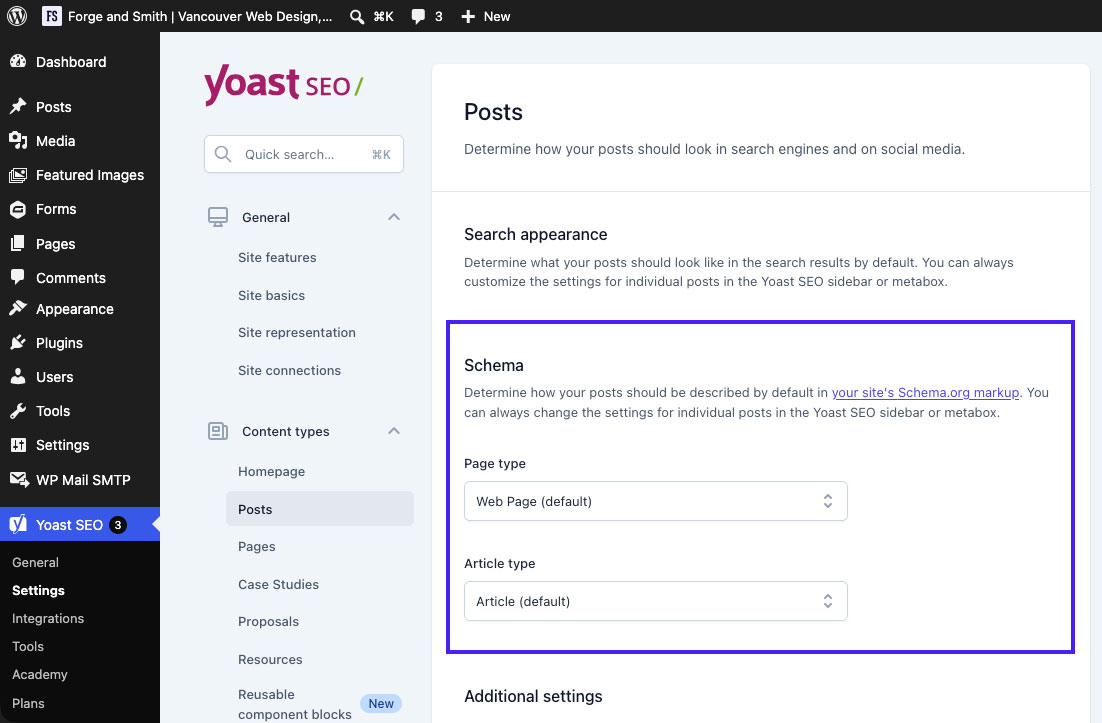
We set up Yoast SEO on every WordPress site that we build, and it handles Organization, WebSite, WebPage, Article, and Person schema on its own (our Yoast, GA4, and Tag Manager primer covers the setup). For most sites, that’s plenty. We’ll scope custom schema when there’s a specific rich result worth chasing, and we’ll tell you when there isn’t.
What actually drives AI visibility, and where does schema fit?
Google’s AI features are rooted in the same core ranking systems and search index as its regular results, so much of the work that earns rankings also creates the conditions for AI visibility, and schema is a thin labelling layer on top.
Other AI tools run their own retrieval, so the overlap isn’t identical everywhere, but Shepard’s review points the same way across ChatGPT, Gemini, and Perplexity. He scored each factor out of 10 based on how consistently it showed up across studies, how strong the underlying data was, and whether official documentation supported it. These are evidence scores for correlation, not measured effect sizes.
His top-scoring factors for AI citations are:
- Whether the page is accessible and crawlable (9.5)
- How the page ranks for the search itself (9.4)
- How it ranks for the related follow-up searches that AI tools run behind the scenes (9.3)
- Whether snippet and preview settings let search engines show the content (9.2)
- How closely the content matches the question being asked (9.2)
Structured data came in at 5.6. Content placed in visible text, rather than tucked behind tabs or scripts, scored 7.6, which is higher than the schema that would describe it.
In practice, that means putting the answers on the page. If a question matters to your customers, answer it in visible copy, in plain language, where they’d expect to find it. Google’s guide also singles out unique, non-commodity content as the thing most likely to shape your presence in AI search over the long run, which for most businesses means writing down what you know from doing the work instead of summarizing what everyone else has already published.
Two housekeeping items round out the learnings. Don’t block the snippet and preview settings that AI features depend on (we covered Google’s new AI opt-out switch, and why almost nobody should use it, in Noise vs. Signal Issue 03). Then open the generative AI performance report in Search Console and see how often your pages already turn up in AI features before you change anything.
What should you do with schema on your site?
Treat schema as maintenance rather than strategy: confirm that what you have is accurate, add markup only where it unlocks something specific, and put your real effort into the content that schema describes.
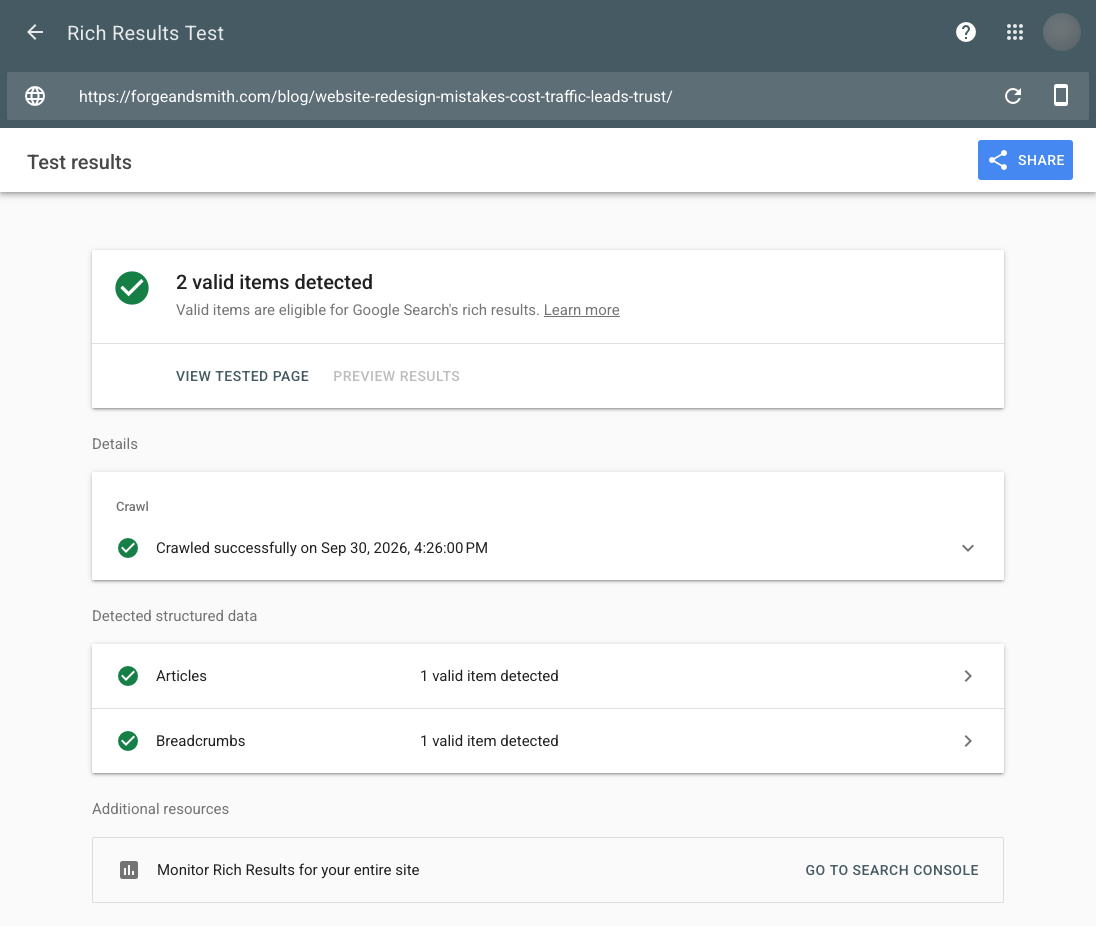
- Check what’s already there. Run your key pages through Google’s Rich Results Test and look at the enhancement reports in Search Console. If you’re on WordPress with Yoast, you probably already have a decent baseline and just didn’t know it.
- Make sure the markup matches the page. Every fact in your schema should be visible on the page, too.
- Leave FAQ schema where it is. Put the effort into the questions and answers that people can actually read on your pages.
- Only add type-specific schema where there’s a payoff. Products, events, and local details are worth doing properly. A blanket “full schema implementation” usually isn’t, and if it’s being sold to you as an AI visibility package, that’s a big red flag.
- Pressure-test any AI schema pitch. Google now publishes guidance on evaluating third-party SEO advice, and its AI guide sends readers there when it talks about AEO and GEO services. Ask whoever’s pitching what evidence they’re working from.
- Get a baseline first. Note your AI impressions before you change anything, or you’ll never know whether it worked.
Conclusion
Schema is useful and narrow, and is constantly being oversold.
It does get pages into the rich results that are left, it helps machines read prices and dates properly, and it costs almost nothing to maintain once a plugin is handling the basics.
It won’t lift your rankings. The best evidence we have said that adding it doesn’t measurably increase AI citations, either.
When clients ask us for schema, what they’re usually asking is how to show up when someone asks an AI tool about what they do. That answer hasn’t changed much: rank for the questions your customers are actually asking, on a site that’s easy to crawl, with answers specific enough that an AI tool would rather quote you than paraphrase someone else. Schema can label that work, but it can’t substitute for it.
If you want a little more detail on how we handle schema on our builds, it’s in our Schema: What to Know resource. We also cover what’s actually changing in AI search once a month in Noise vs. Signal. It’s free, and it’s written for in-house teams who don’t have time to follow all of this themselves.
Want a second opinion on what your site actually needs? Talk to our SEO consulting team.
Share post:

About the Author
More by This Author