
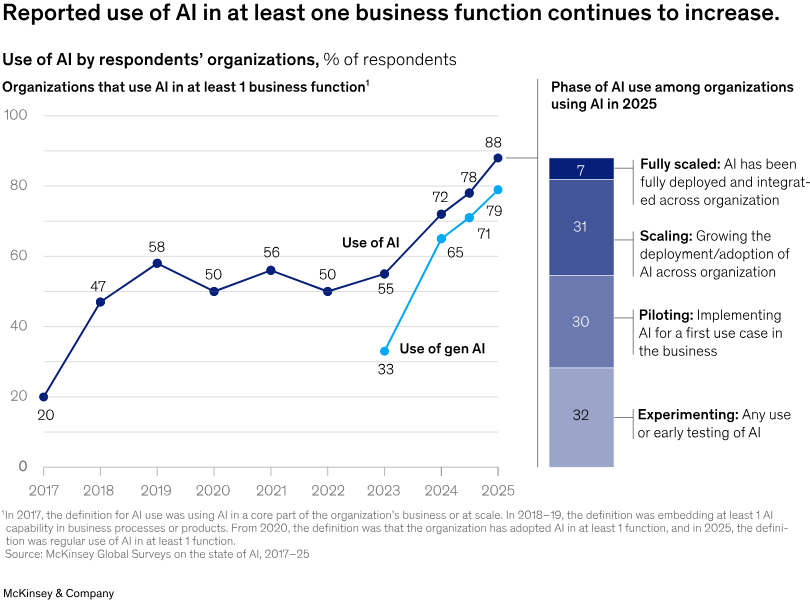
88% of organizations now use AI in at least one business function, according to McKinsey’s 2025 State of AI report. Among small businesses, the U.S. Chamber of Commerce puts that number at 58%, up from 40% the year before.
The upside is real. Chatbots handle after-hours inquiries, recommendation engines surface what visitors actually want, and automated workflows cut the cost of qualifying leads.
But there are also legal liabilities that can complicate this use. For instance, when an AI chatbot gives inaccurate financial, medical, or legal information, your business may be exposed to claims of negligence or misrepresentation.
This can result in lawsuits, data privacy breaches, monetary litigation, and even damage to brand reputation.
In this article, we’ll discuss the legal liability areas to look out for and how to ensure the use of AI on your website remains compliant.
What AI on Your Website Actually Involves
At the simpler end, it might be a chatbot that answers frequently asked questions or routes inbound service requests. At the more complex end, it could be a recommendation engine trained on behavioural data, an automated screening workflow for inquiries or applications, or a generative tool producing content and images for your pages.
For instance, a local electrical contractor in St. Louis might add an AI chatbot to handle after-hours service calls and collect job details before a technician follows up. The moment the chatbot receives a customer’s name, address, and problem description, data privacy obligations apply.
The same logic applies to a vacation rental website builder platform. The platform could use an AI recommendation engine to match prospective guests with available properties by considering guest preferences, browsing behaviour, and personal details.
The scope also extends to tools you did not build yourself. Talking about:
- Third-party analytics platforms
- A/B testing tools
- Session recording software (such as heatmap tools)
- Ad tech integrations
All of these potentially fall under the same legal framework as purpose-built AI features. So long as a tool processes personal data about your visitors, your obligations as the data controller don’t disappear because a vendor built the underlying model.
Paxton Luke, General Manager at Rogue Valley Heating, Cooling & Electrical, describes the moment the question became real for his team.
“When we started looking at AI tools to handle after-hours service requests on our website, the first question wasn’t about cost. It was about what happens to a customer’s name, address, and problem description once they submit it. Was it safe? Was the collection process compliant? AI definitely makes things easy for both you and the businesses you serve. But because it’s easy doesn’t mean it’s safe, and that fine line can cost your brand a lot if you’re not careful.”
What’s the Legal Outlook on AI use for Websites in 2026?
Privacy law has existed for years, but it was written for a world where websites collected data and humans made decisions.
Now, AI changes two things that the existing law wasn’t designed to handle well. It introduces automated decision-making at a scale and speed where human review can’t realistically keep pace.
Moreso, AI raises entirely new questions about authorship, training data, and who is responsible when a model produces a harmful output.
And here’s how legislators are responding to that:
The EU AI Act Introduces Risk-Based Obligations
The EU AI Act, adopted in 2024 and rolling out through 2026 and beyond, is the first comprehensive regulatory framework built specifically for artificial intelligence. It classifies AI systems by risk level and assigns obligations accordingly, covering transparency requirements, documentation standards, conformity assessments, and human oversight mandates for higher-risk deployments.
Penalties sit at the GDPR scale, up to €30 million or 6% of global annual turnover for the most serious violations. If your website serves EU users, this framework applies to you regardless of your business’s headquarters.
North American Laws Are Filling the Gaps
In the United States, California’s CCPA/CPRA addresses transparency and consumer rights regarding data sharing, and its definitions are broad enough to encompass many AI-driven personalization tools.
Colorado’s AI Act (SB24-205), effective in 2026, is the first broad U.S. state law to directly regulate high-risk AI systems. It requires documented risk management programs, consumer disclosures, and bias testing. The FTC has also warned businesses that misleading AI claims and unfair automated practices are enforcement priorities. Additional state laws are in development.
Canada sits under two overlapping frameworks. Quebec’s Law 25 introduced strict requirements on consent, transparency, and incident reporting that apply to any automated processing that affects Quebec residents. Federally, Canada’s proposed Artificial Intelligence and Data Act (AIDA) is advancing through Parliament with a risk-based oversight model similar in structure to the EU approach.
Three Legal Liability Areas Your Website AI Creates
If you’re using AI on your website, there are three legal gaps to look out for. That includes consumer data privacy, intellectual property, and automated decision-making.
1. Consumer Data Privacy
If your site’s chatbot learns from past service transcripts, your recommendation engine monitors browsing patterns, or your personalization module tracks return visits, you are processing personal data.
Under the General Data Protection Regulation, that activity requires a lawful basis, transparent disclosure of automated decision making, and, in many cases, a clear right for users to object to profiling that has significant effects on them.
California law creates additional exposure. Under the California Consumer Privacy Act and the California Privacy Rights Act, sharing personal data with a third-party model provider may qualify as a sale or disclosure, depending on the commercial arrangement and whether valuable consideration is involved.
Obligations increase further when children are part of your audience. The Children’s Online Privacy Protection Act imposes stricter consent, notice, and data handling requirements if any portion of your users is under 13 years old.
Cross-border data transfers also have legal boundaries. If you’re moving EU visitor data to a U.S.-based AI infrastructure, it requires either the EU-U.S. Data Privacy Framework or Standard Contractual Clauses as the legal mechanism for that transfer.
Vendor relationships add another layer. Most AI features on small business websites come from third parties. If your data processing agreement with a vendor doesn’t accurately reflect what the tool actually does with visitor data, that mismatch belongs to you when a regulator investigates.
2. Intellectual Property and AI-Generated Content
If your website uses AI to produce blog posts, product descriptions, social copy, or images, the question of ownership remains unsettled. The U.S. Copyright Office has stated that works created without human authorship are not registrable and has issued guidance requiring disclosure of AI contributions in copyright applications.
The issues of training data are also actively litigated. For instance, Getty Images sued Stability AI over alleged unauthorized use of its photo library for model training. The New York Times sued OpenAI and Microsoft over news content used to train language models. Even if your website only consumes an API rather than training its own model, you can face takedown demands when generated content reproduces or closely resembles protected material.
3. Automated Decision-Making and Discrimination
This is where the stakes get highest, and where the fewest businesses have done the necessary preparation. Automated decisions that screen, rank, or route people in areas like employment, lending, housing, insurance, or access to services can violate anti-discrimination law even when no human made the call.
U.S. federal agencies, including the DOJ, CFPB, EEOC, and FTC, issued a joint statement warning that AI-enabled bias will be treated as a civil rights violation across their respective domains.
The EEOC settled with iTutorGroup for $365,000 after an algorithm reportedly rejected older applicants based on age, with no human reviewer catching the pattern.
Bryan Henry, President at PeterMD, North America’s largest online men’s health clinic, describes what this obligation looks like when patient data and automated workflows intersect.
“In a healthcare setting, you cannot let AI influence clinical decisions without human oversight and a clear audit trail. Our patients share deeply personal health information to get care. Every automated feature on our platform gets reviewed against HIPAA requirements before it goes live. When patient data is involved, compliance is not optional.”
In lower-stakes contexts the threshold differs, but the underlying principle remains the same. If your website uses AI to sort, score, or route people, you need to understand which factors the model is weighing and whether any of those factors correlate with protected characteristics.
How to Address AI Legal Liabilities on Your Website
There is no single control to flip here. What protects you is a combination of written policy, regular auditing, technical safeguards, and documented vendor management. Here’s how to implement them.
1. Write and Enforce an AI Use Policy
Your policy needs to clearly answer enough core questions that any team member can follow it without guessing.
- Which tools and use cases are approved?
- What data categories can be fed into AI systems?
- What disclosures do visitors receive?
- Who owns AI-generated outputs?
- What does the escalation process look like when a feature produces a harmful or unexpected result?
The NIST AI Risk Management Framework offers a solid structure for building this without starting from scratch.
Ryan Walton, Program Ambassador at The Anonymous Project, where he coordinates campaigns and builds trust with partner donors, identifies the trust dimension that policies need to address directly.
“Donors give based on trust. If your website uses AI to manage communications, segment audiences, or automate donation flows, your supporters need to know how their information is used. For an organization built around anonymous giving, that’s not a legal footnote. It’s central to how we operate.”
This applies well beyond the nonprofit context. Any website where the visitor relationship depends on trust, service providers, healthcare platforms, professional services firms, needs to treat AI transparency as a credibility question, not only a compliance checkbox.
2. Run Compliance Audits on a Regular Schedule
AI tools change over time. Vendors push model updates, feature flags get toggled on, and integrations expand. A privacy notice that was accurate when you launched a feature may no longer reflect what that tool does six months later.
That’s why you need to run compliance audits regularly. Here’s how:
- Start with a data map that traces every personal data point your AI features touch, from collection through processing to storage and deletion
- Follow that with a fairness review of any automated decisions your site makes, with documented testing methodology
- Then run a vendor assessment, checking whether your data processing agreements still match current tool behavior
- Close with a transparency review confirming that your privacy notices and on-site disclosures are still accurate
In the EU, Data Protection Impact Assessments are required for high-risk processing, and the EU AI Act anticipates the need for risk management documentation for higher-risk AI systems.
3. Build Human Review Into Automated Processes
This does not mean you need a human to approve every chatbot response. It means that where AI outputs or decisions could materially affect someone, a human should be in the loop before that decision becomes final, and a record of that review should exist.
If your developer is integrating AI-powered features, the technical architecture should include logging, override controls, and user-facing disclosure. That applies to features like:
- A dynamic intake form that routes inquiries by type. The routing logic needs to be auditable, and someone on your team should be able to override where a submission lands
- A chatbot that collects personal details. Every data point it captures falls under your privacy obligations, and visitors should know they are interacting with an automated system
- A recommendation engine influencing which services a visitor sees. If the model is surfacing options based on behavioral data, that processing needs to be disclosed and documented
4. Manage AI Vendors With the Same Rigor as Your Own Code
Many of the obligations that apply to your site’s AI features flow through third-party tools you did not build. The chatbot provider, the recommendation engine vendor, and the analytics platform each involve data processing relationships that need to be formally documented.
- Confirm that your data processing agreements accurately describe what each tool does with visitor data
- Keep your subprocessor lists current
- If a vendor processes data in a different country, verify that you have the correct legal transfer mechanism in place; require vendors to notify you of any changes to their models or data practices
This ensures you are the data controller, and the liability sits with you.
Conclusion
Adding AI to your website changes your legal profile, whether you planned for it or not. Privacy obligations activate the moment a chatbot collects a name. IP questions surface the moment a model generates content you publish. Discrimination risk enters the picture the moment an automated system influences who gets what.
None of that means you should slow down on the tools.
It means you need your policies, your audit process, your vendor agreements, and your human review checkpoints to keep pace with what you deploy. In addition, stay up to date with the laws surrounding AI use in your areas of operations and consistently iterate.

About the Author
More by This Author
About the Author
David Abraham
David Abraham is a tech lawyer with extensive experience in artificial intelligence, financial technology, human rights law, and digital marketing.
Contact More by This Author