
AI can write faster than any copywriter you know, which is useful if you’ve got limited resources and need to produce content for your business. But you can’t depend on it to nail your brand voice.
If you do, you’ll suddenly realize almost every one of your blog intros begins with the same generic sentences, your copy’s personality has slid from professional-yet-friendly to rigidly corporate, and nothing feels aligned with your brand strategy. Suddenly you’re editing that AI draft so much it looks like a mangled porcupine
Not so good, right?
You don’t need to keep AI out of your content creation process over fear that it’ll dilute your brand voice.
Instead, take advantage of its efficiency and blend it with human creativity to achieve both speed and credible content that correctly portrays your company’s personality.
In this article, we will show you how to do exactly that.
What does it mean for your brand voice to be diluted?
Brand voice is a consistent personality that consumers associate with your business. This could be anything from warm and welcoming to sassy and cheeky, highly technical, innovative, empathetic, or even nostalgic.
A strong brand voice fosters trust across all channels, including social posts, blogs, and email marketing. When all of these touchpoints sound aligned, customers connect more easily with your brand.
However, this voice can be diluted when you let AI take sole responsibility for creating your content. Here’s what that looks like:
- Generic: The phrasing sounds like every single other website in your niche.
- Loss of emotional depth: A quirky, bold brand suddenly sounds mildly enthusiastic.
- Inconsistency: Your personality changes from one AI-produced piece of content to another.
Many brand leaders worry that using AI to write marketing content will strip their brand of its personality. But at its root this concern isn’t necessarily about AI’s technical capability—the same companies often trust AI with responsibilities that carry far greater consequences than an incorrect tone. You only need to glance at an AI bookkeeping software comparison to see how widely AI is used to manage financial records, taxes, payroll duties, and other critical business functions.
Business owners will trust AI with their money, but creativity is a whole other topic. And when it comes to writing branded copy, AI’s capability is entirely dependent on how it’s guided (including whether it’s guided at all). Guidance is what prevents dilution.
What happens when your brand voice changes?
If consumers find it difficult to associate your brand with a single voice, or no longer perceive the voice that initially drew them to your business, this negatively impacts their trust.
According to Edelman’s report, 81% of consumers view trust as essential before buying or recommending a brand.
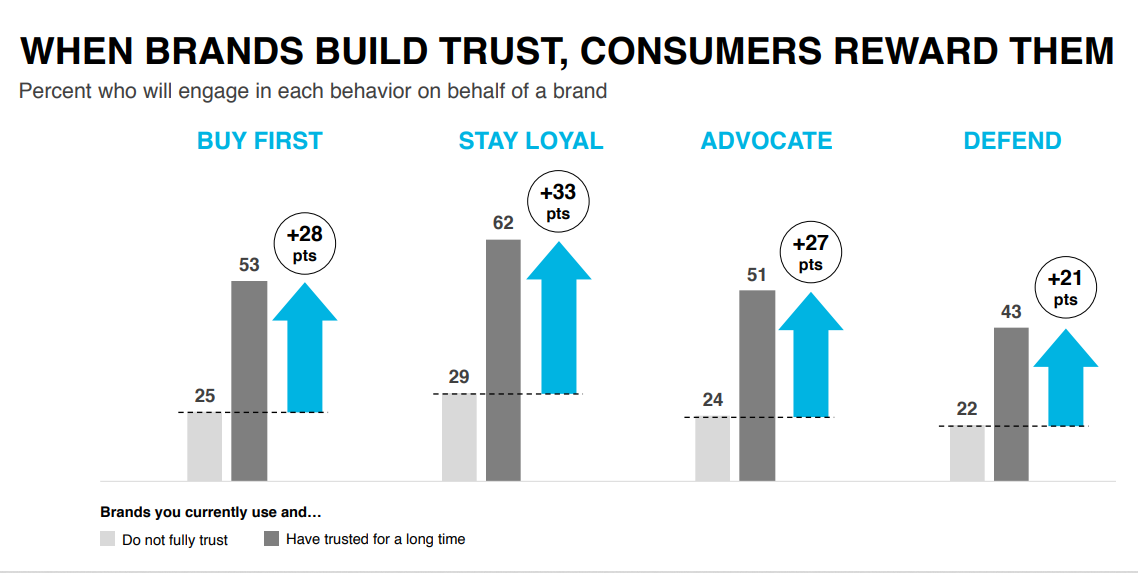
In a nutshell, a diluted brand voice can cost you loyalty, customers, free advocacy, sales, and ultimately, total revenue.
How does unguided AI use impact your brand voice?
A recent report from Ahrefs reveals that 87% of surveyed content marketers, encompassing both B2B and B2C sectors, utilize AI tools such as ChatGPT and Claude to create content. While this shortens publication timelines, letting AI heavy-lift your content creation process can result in:
- Robotic messaging with generic delivery and lacking a relatable personality
- Close but incorrectly portrayed personality, especially with an improperly prompted or untrained AI
Brand voice describes your brand’s personality, and plays a big part in retaining people who discover your website—and converting them into leads or customers. If your copy doesn’t give them the right emotional reaction, they’re likely to leave and never come back.
Take Duolingo, the language learning platform, as an example. Duolingo employs a youthful, cheeky-yet-focused personality when addressing audiences via its unified communication channels. See a sample email below.

Now imagine the same email but with this message:
“Dear Davis, your subscription to the Super plan has been activated. Go to your dashboard to access advanced features.”
Technically still correct, yet something feels off, right? Duolingo’s brand voice is warm, exciting, and motivational, and the second message sounds flat. That sudden disconnect, if it occurs frequently, could confuse Duolingo’s users and make them lose interest in the app.
Educational businesses can thrive when their messaging evokes expertise and genuine care about successful outcomes. Another example is promoting an online Latin course using clear, engaging, and inspiring language to help audiences feel supported.
Should you use AI to write branded content?
The short answer is yes, but never unguided, never without human review, and not for your most critical conversion content. Where AI can be most useful is helping you write branded top-of-funnel content.
When you shouldn’t rely on AI for brand communication
The use of AI for certain aspects of your brand communication should be totally avoided to prevent your brand voice from being portrayed incorrectly.
Crisis Communication and Sensitive Messages
Sensitive messages and crisis communication require extreme caution, as they can instantly do irreparable damage to your brand if the tone is even slightly off. This includes messages like condolence outreach, announcements during global crises, customer apology emails, and anything that touches on bad news or social issues.
You definitely don’t want to sound upbeat while extending support to people dealing with a natural disaster or a mass layoff, even if that is your brand voice.
Key Campaigns that Define Perception
Picture a B2B company preparing a local campaign to strengthen its position as the most dependable partner for enterprise clients in California.
AI might generate a broad message, such as “We support enterprise success with tailored solutions.” This doesn’t reflect the local nuances that matter.
A human-written version can communicate something more grounded, such as “California companies move fast, face strict compliance rules, and operate under constant market scrutiny. We support the leaders who manage these demands with solutions built for their environment.”
If the content needs to define how the public perceives your brand, regardless of the magnitude, you shouldn’t leave it to AI in any way.
5 tips to blend human creativity with AI efficiency
AI speeds up content creation and lowers operational costs, so it makes sense to take advantage of it wherever it’s useful. Here’s how to do it without harming your brand voice.
1. Create a Comprehensive AI Use Guide
Traditional content guides primarily focus on content tone, grammar rules, visual style, colour palette, typography, formatting standards, and examples of approved messaging. These are all important for human-only content teams, but they are insufficient for a hybrid human-AI team.
For proper use, you need a guide that covers which content categories are suited to AI, phrases to avoid, maximum AI contribution, and draft grading.
Content Category
Divide your content into low-risk and high-risk.
Low-risk B2B content includes product descriptions, meta descriptions, social media post captions, blog post outlines, and FAQ pages. You can train your AI tool to handle this category with minimal human intervention.
High-risk content includes brand statements on social issues, mission and vision statements, taglines, core website copy, major campaign messaging, press releases, customer apology letters, escalated conversations, and other sensitive or emotionally charged messages. Since these are high-impact, this content needs to be highly human-led with some support from AI.
Assistance here should focus on research. AI excels at gathering concise information that helps your team work faster and frame ideas with clarity. For example, a law firm marketing team could ask AI to scan case laws and produce an organized outline of the main questions people have about the personal injury process. The human content team can then take that outline and develop the final copy with accuracy and empathy.
Or a local service provider, such as an electrician in St. Louis, could use a prompt like “Scan the top ten local forums and review sites to identify the main frustrations people mention.” This gives the team quick insight into real concerns, allowing writers to craft an empathetic, on-brand message with the right tone.
Key Phrases to Avoid
In a study conducted by Bynder, the CX brand found that over 50% of consumers can detect if a copy is AI-generated, and 44% of them report feeling less engaged once they notice. That means when your brand voice begins to sound less human and more like AI, you risk losing a significant portion of your consumers to another competitor.
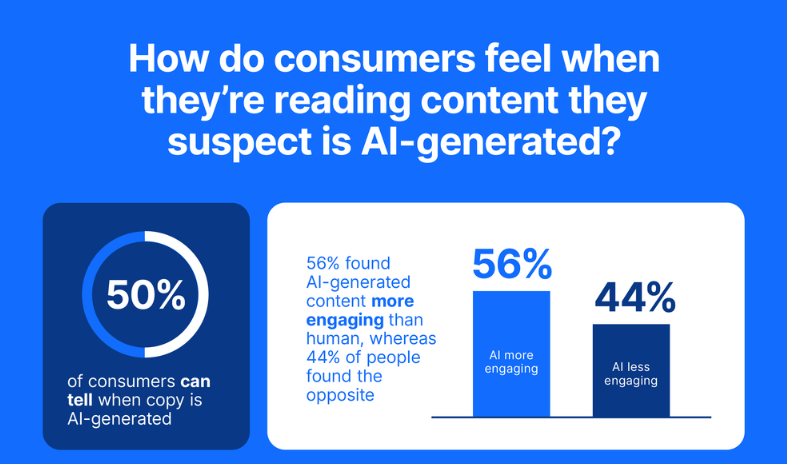
One way your AI-generated copy gives itself away is through the common sentences and phrases that AI tools use. You can find lists of examples, like this one from Grammarly.
Your AI guide and content briefs should be regularly updated with phrasing to avoid. Ensure you provide alternative synonyms or vocabulary that your content team can always switch to if necessary.
Maximum AI Contribution Percentage
Unrestrained AI use will eventually influence your brand voice and stifle creativity. To counter this, you need to cap how much of it you allow in your content. Start by dividing all aspects of your content creation process into sections. Then, assign each section a score, such as 5% or 10%.
For instance, your sections can include ideation, outlines, parts of the drafts, and editing. To be on the safe side, don’t exceed the 30-50% cap, which should primarily be allocated to ideation and outlines.
Draft Grading
Design a scoring system that evaluates human-with-AI content before rolling it out. An example is this Writing Rubric, which has four stages and considers four phases: knowledge, clarity and coherence, rhetorical choices, dependability and reliability, and strategic writing.
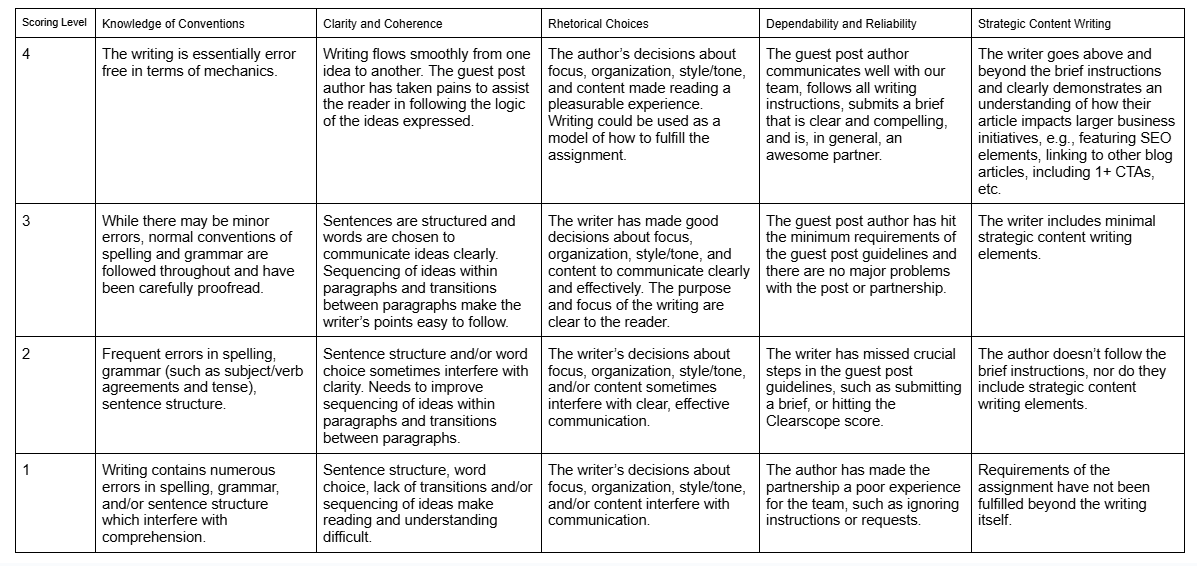
Yours needs to be slightly different since you’re considering AI use. Your rubric could cover clarity, consistency, engagement, originality, accuracy, and sentence structure.
2. Use AI for Support Only
Except in low-risk content, AI should never be responsible for your first draft. It can help you rewrite paragraphs, make them sound more exciting, flag broken sentence structures, or give alternatives. But that should be it.
AI can also serve as your editor, but not as your chief lead. Once you’ve completed the first draft of any content, paste it into GPT and ask it to assess the structure, coherence, relevance, and value with respect to a provided guideline or a reference website post. This will help you identify many things that Grammarly misses.
For instance, a service like a debt relief company needs to build its entire brand voice on a foundation of trust, empathy, and non-judgment. AI can come in as an editor to make the final output sound fully neutral.
Another aspect of AI that’s gaining traction with brands is using AI to refine keywords that are optimizable for your content, verify their relevance, and cross-check performance using a website SEO checker.
3. Train AI on Your Existing Content and Brand Guidelines
AI can only be the perfect assistant when it understands your brand needs, tone, voice, identity, and guidelines. These data points protect against incorrect phrasings, pulling information from sources that do not align, or producing outputs that don’t reflect your brand’s personality.
Leverage the premium versions of ChatGPT, Perplexity, Gemini, or Claude and be sure to control data privacy via the settings.
The things to feed your AI depend on your brand, industry, and market. Let’s say you own a project management software that helps companies streamline project creation, automate workflows, and track progress. The AI tool you will use for branded content creation should understand:
- Industry terms and jargon, such as resource allocation, task dependencies, sprint cycles, backlog refinement, and workload planning
- Regulatory or organizational standards that influence project delivery, such as quality assurance rules and internal governance structures
- User pain points such as unclear task ownership, scattered communication, slow handoffs, missed milestones, and tracking issues across multiple teams
- Your brand’s voice, tone, personality, and style
- Competitor positioning, so it does not produce generic content and reflects your unique value
Creating a content framework per content type can also be effective, especially for social media content that is primarily generated by AI.
Examples include AIDA (Attention, Interest, Desire, Action), PAS (Problem, Agitate, Solution), BAB (Before, After, Bridge), 4Cs (Clear, Concise, Compelling, Credible), and FAB (Features, Advantages, Benefits).
4. Require Content Review Before Publication
Despite carefully building frameworks and following a unique AI-human guide, content output may still fall outside the guardrails of your brand and contradict your brand voice. You need to set up a manual review process to monitor any content your brand wants to put out there.
For this, you can use a linear flow, iterative flow, or stage-gate flow.
- Linear flow: Content progresses from “Research → Draft → Edit → Approve → Publish.” This approach works well for low-risk content, such as brief social media posts.
- Iterative flow: A slight extension of linear flow, starting from “Research → Draft → Review → Revise → Final Review → Publish.” Great for more targeted low-risk content like blog posts.
- Stage-gate flow: More complex and thorough, consisting of “Brief → Draft → Gate 1 Approval → Edit → Gate 2 Approval → Publish.” Ideal for high-risk content.
You can add as many gates for review and approval as needed, depending on the content type. However, each review stage should include a checklist covering brand voice, tone, messaging, phrase usage, and sentence structure.
Reviewing brand tone is crucial because if voice is what you say, then tone is how you say it. If your AI gets the tone wrong, your brand voice will suffer.
5. Regularly Audit Existing AI-Generated Content
Brand standards are not static. Your offerings will become wider or narrower, you will adopt more messaging channels, your teams will change several times, you will need to conduct repeated onboarding, and AI tools will also become smarter.
Therefore, review your AI-human scoring rubric regularly, refine the audit process, and update your list of generic AI phrases to flag or bypass accordingly.
See which low-risk content has graduated to high-risk depending on online sentiment, and continuously look for ways that AI can handle more of your content without impacting your brand voice.
Wrapping up
AI is here to stay, and you can’t omit it from your content process if you want to remain competitive. But you also need to set guardrails that prevent this innovative tech from diluting your brand voice.
Keep AI in a supportive role and let your human team take the lead. Train your system on existing brand content and guidelines, and introduce a manual review flow to eliminate inconsistencies. And finally, regularly audit your existing content to ensure it meets dynamic brand standards.
Share post:

About the Author
David Abraham
David Abraham is a tech lawyer with extensive experience in artificial intelligence, financial technology, human rights law, and digital marketing.
Contact Us More by This Author